

Do you design your habit building for your best days? Do you assume you’ll have the time, the energy, the motivation, and the conditions to execute the full version of the thing you’ve committed to doing?
On your best days, that’s fine, it’ll work. However, your worst days are the days that determine whether a habit survives. The tired days. The stressed days. The days when the plan collides with reality and reality wins. Those are the days that matter most, and when your habit system has no answer beyond “try harder” you’re in trouble.
There’s a better approach. It’s called the Minimum Viable Action.
Hey there. It’s me, Kore. And you’re listening to Exercising Self-Control: From Fitness To Flourishing.
What a Minimum Viable Action Actually Is
A Minimum Viable Action (MVA) is the smallest, simplest version of a behaviour that still counts. The version you can execute even on your worst day, with minimal equipment, no preparation, and no negotiation required.
One page of reading. A single paragraph of writing. Three mindful breaths for meditation. Ten bodyweight squats in your living room for your fitness.
These are the bridge. The thing that keeps the habit alive when life makes the full version impossible. And keeping the habit alive is the whole point.
The Real Purpose Is Identity
Here’s what you may not have considered about the MVA: it’s primarily about identity, and only secondarily about performance.
Every time you execute your minimum viable action, even the embarrassingly small version, even when no one is watching and nothing impressive is happening, you are feeding your brain a piece of evidence: I show up. I am someone who does this. Even on hard days, I do this.
That evidence accumulates. Over time, it becomes the foundation of a self-concept far more durable than motivation. Motivation rises and falls with mood, circumstance, and energy. Identity, built through consistent action, holds. It becomes the thing you return to because it’s who you are.
Consistency builds identity. Identity sustains consistency. The MVA is the bridge between the two on the days when everything else fails.
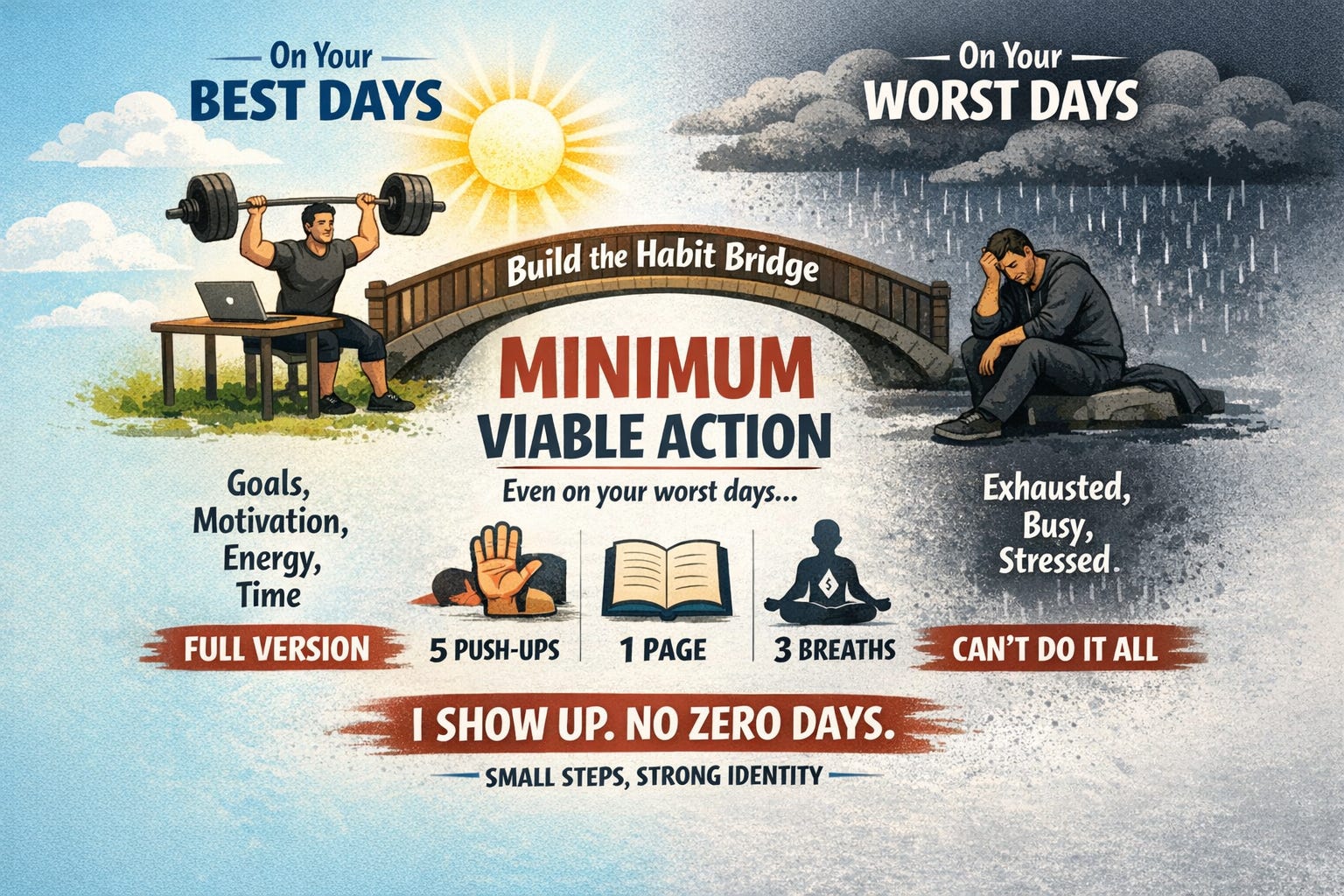
Image generated using Copilot AI.
How to Design One That Actually Works
An effective MVA meets four criteria:
Embarrassingly small. If it feels too easy, you’re probably on the right track. The urge to make it more impressive is the urge that kills consistency. Resist that urge.
Frictionless. Minimal equipment or, even better, no equipment. No setup. No preparation required. Every barrier, even a small one, is a reason to skip. Remove every reason you can.
Binary. Either done or not done. No ambiguity, no partial credit, no “I sort of did it.” The clarity of a binary standard is what makes it a real commitment rather than a vague intention.
Holds on your worst day. The standard to aim for: Even on my worst day, I can, I will, and I am doing this. If it’s not true of your MVA, make it smaller until it is.
The goal is consistency, not impressiveness. Habits do not need to be impressive to be permanent. They need to be doable.
The All-or-Nothing Trap
The belief that a partial session doesn’t count is common. It is also the belief that kills more consistency than laziness.
The MVA is a direct answer to this all-or-nothing trap. It lowers the barrier to starting, and starting, more often than not, leads naturally to continuing. You sit down to write one paragraph and find yourself writing three. You drop to the floor for five push-ups and end up doing fifteen. The full session emerges from the minimum action, not in spite of it.
And even when it doesn’t, even when five push-ups is all you have, that still counts. Starting a habit over after missing a day is significantly less effective than simply keeping it going. The psychological cost of a zero day is real. The MVA prevents it.
The Protocol for Your Worst Days
This works best when treated as a protocol, not a concept.
Execute it at the same time and in the same sequence as your full practice. If you’re sick, do it gently. If you’re travelling, do it in the airport, the hotel room, the back of a cab (probably not push ups but a short meditation). If you have no motivation and no time, do the sixty-second version and move on.
The rule is simple and absolute: there are no zero days.
By performing even the minimum, you feed your brain the training data it needs: I show up. That signal, repeated daily, keeps the neural pathways active and dominant. Miss a day and the old patterns begin to reassert themselves.
Keep the streak alive, even by the thinnest margin, and the new identity holds.
Small Is Strategic
An action doesn’t need to be impressive to be effective. It needs to be consistent with your values and goals.
Your MVA is the anchor that keeps your identity steady through chaos, fatigue, travel, and the unpredictability of events and circumstances. It ensures that even on your worst day, you still show up as the person you’re committed to becoming.
If you want a habit to last a lifetime, don’t start with the maximum you can do once in a while. Start with the minimum you can always do.
A Community For Practice
Would you like to put ideas like this into practice?
On April 2nd I’m launching a free community on Skool called Exercising Self-Control.
The community exists for one reason: To help you use your body to train your mind. Discipline is the outcome.
No hype, no drama. Just deliberate action and identity-based training. You’ll change your body. More importantly, you’ll establish an exercise practice that will change the trajectory of your life. The link is in the show notes.
That’s it for today. Catch you next time.


