

Last episode, I defined intensity as the signal you send when you choose the slightly harder version of the work you are already doing. Not a program. Not a protocol. A choice made in the pause between sets.
That definition is true, but it is incomplete. Knowing what intensity is does not tell you how to apply it without breaking yourself. And that is where most people get it wrong.
Today we address the how with micro-intensity: the smallest increase that still registers. The minimum viable demand that triggers adaptation without inviting burnout.
Hey there. It’s me, Kore. And you’re listening to Exercising Consistency: From Fitness to Flourishing.
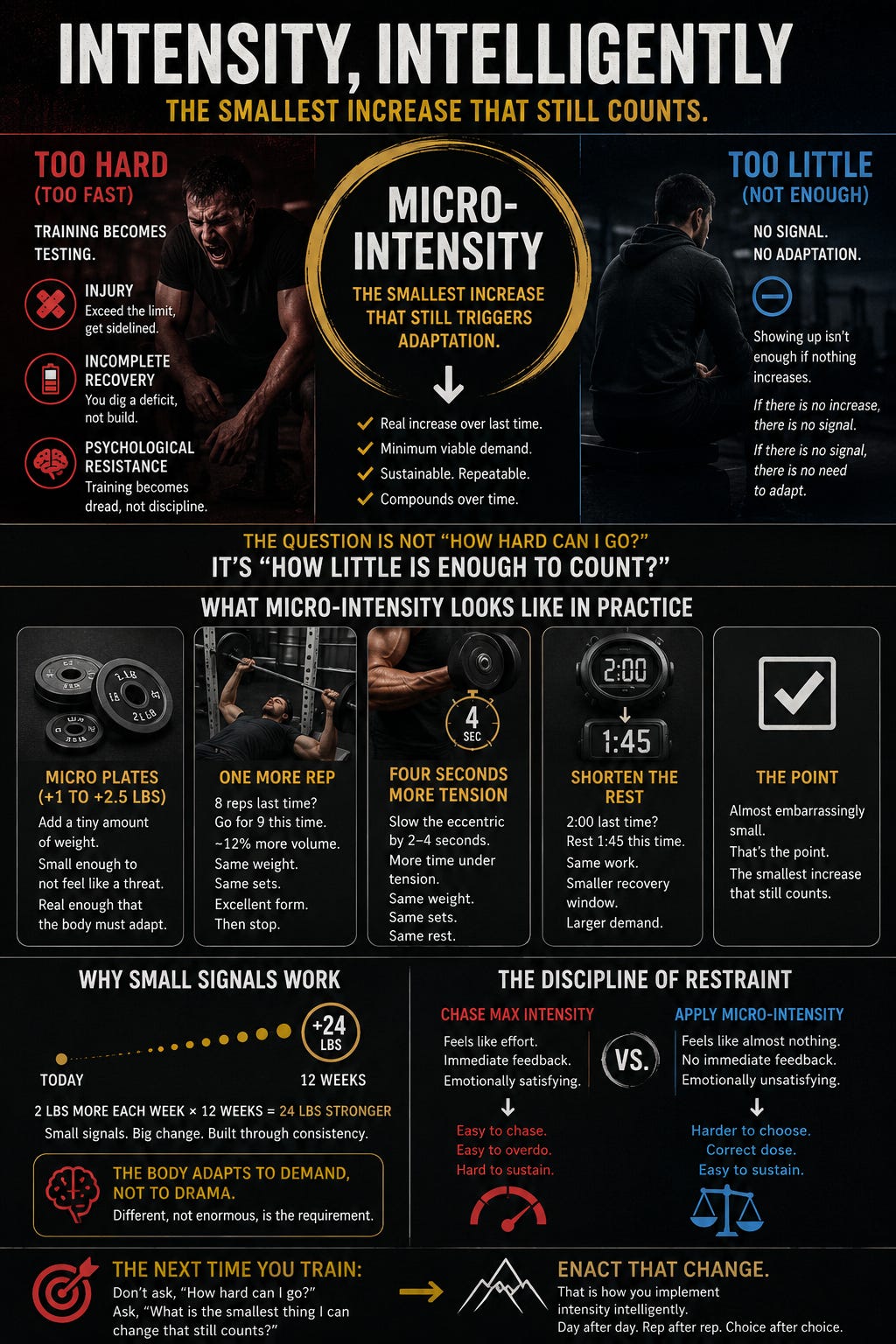
Image generated using ChatGPT.
What Micro-Intensity Is Not
Micro-intensity is not maximum effort. It’s not the set where you see stars. It’s not the workout that leaves you on the floor.
Those experiences have their place, but they are not the daily practice of intensity. They are peaks. And if you treat every session as a peak, you are not training you are testing. And the body cannot sustain a consistent pattern of testing indefinitely.
Micro-intensity is also not zero. It is not simply “showing up is the win” dressed in different language. The signal must be real. It must represent an increase over the last comparable effort. If there is no increase, there is no signal. And if there is no signal, there is no need for the body to adapt.
The question micro-intensity answers is not “How hard can I go?“ It’s “How little is enough to count?“
The Problem With Going Too Hard
The body is an honest teacher, but it is also a conservative one. When you apply too much intensity too fast, the body does not respond with unlimited adaptation. It responds with alarm.
Excessive intensity produces three predictable outcomes.
Injury. Tissue tolerance has a ceiling, and exceeding it does not make you stronger. It makes you sidelined.
Incomplete recovery. If the stimulus outpaces your ability to recover from it, each subsequent session begins from a deficit. You are not building, you are digging.
Psychological resistance. The mind begins to associate training with dread. The workout that should be a rehearsal of discipline becomes something you must talk yourself into.
None of this is the fault of intensity. It is the fault of intensity applied without calibration. The signal was real, but the dose was wrong.
What Micro-Intensity Looks Like in Practice
Micro-intensity operates on a simple principle: the smallest increase that still triggers adaptation. The key word is smallest. Not impressive or dramatic. Functional.
Here is what that looks like in the gym:
The micro, fractional, adder, or add-on plates.
These can be as little as one pound and up to two-and-a-half to three pounds. The good gyms will have them. And if your gym doesn’t, they’re worth the investment. You just bring them with the rest of your gym kit.
Most people ignore them. Adding five pounds to the exercise is not micro, depending on the exercise in question. It’s standard in generic dumbbell and barbell progression, for example, but it can be too much. But adding just two or two and a half pounds is a signal that is almost impossible for the body to ignore. The increase is small enough that the nervous system does not perceive a threat, but real enough that the body must adapt.
One more rep.
If you benched 135 for eight reps last session, you bench it for nine this session. That single additional rep represents roughly a twelve percent increase in volume. The body notices. But the demand is limited. You are not adding weight, not adding sets, not compressing rest. One rep, maintaining excellent form. Then you stop.
Four seconds more tension.
Slowing the eccentric phase of a single set by two to four seconds (from two seconds up to three or three to four) increases time under tension without changing load, volume, or rest. The muscle works longer at the same weight. That is a signal.
Shortening the rest between sets.
If you rested two minutes between sets last session, you might rest one minute 45 seconds this session. The work is identical. The recovery window is smaller. The body must adapt to performing under slightly greater fatigue.
Each of these is almost embarrassingly small. That is the point.
Why Small Signals Work
The body adapts to demand. It does not require the demand to be enormous. It requires the demand to be different.
A signal of two-pounds more, one rep more, four seconds more, fifteen seconds less are not transformative in a single session. They are barely perceptible. But they compound. Twelve weeks of two pound increases adds 24 pounds to the lift. Twenty four pounds is not a small change. It is transformation, built out of signals so small that no single one of them felt like work.
This is the intelligent application of intensity. Not just harder. A precisely limited harder, sustained over time.
The body is conditioned as the mind is trained. When you learn to apply the smallest effective signal in the gym, you are learning something transferable. You are learning that change does not require a dramatic rupture. It requires a consistent, calibrated demand. Day after day. Rep after rep. Choice after choice.
The Discipline of Restraint
There is a paradox here worth naming. Applying micro-intensity requires more discipline than applying max intensity.
Max intensity is emotionally legible. It feels like effort. It produces immediate feedback: fatigue, soreness, the sense that you did something real. The temptation to chase that feeling is strong, because it lets you confuse the experience of intensity with quality of signal.
Micro-intensity offers none of that. A two-pound increase does not feel like anything. One more rep does not leave you on the floor. The work feels almost the same as last session. And that is the test. Can you trust the signal when it does not produce the feeling? Can you apply the dose that is correct rather than the dose that is emotionally satisfying?
This is The Discipline in its simplest form. A return to the standard and then a small, deliberate raise.
What Comes Next
Micro-intensity keeps the signal real without burning the system. But intensity is not confined to the gym. In the next episode, we will look at intensity everywhere: how the same signal appears in places you are not training and why those edges matter more than you think.
Until then: the next time you train, instead of asking “How hard can I go?“ ask “What is the smallest thing I can change that still counts?“ Then enact that change. That is how you implement intensity intelligently in your training.
An Invitation
If you’re ready to practice this daily, join The ACT Score Challenge.
That’s it for today. Catch you next time.


