

You know that feeling: you’re doing the work and the one number you’re watching refuses to budge. Weight on the scale. Body fat trend. Performance PRs. A friend I’ve been helping put it like this, “I’ve been exercising now for about five weeks, but I still feel fat.”
Whatever the “main metric” is, it starts to feel like proof that you’re failing. But here’s the shift in perspective I want you to make today: Not seeing, or even not feeling, progress doesn’t mean you’re not making progress.
Think of it like this formula: External Circumstance + Our Choice = Our Experience. Your outside world (the circumstances) may be influencing the visible metric right now. But your choices (your consistency, your recovery habits, your training effort, your problem-solving) are still shaping your experience and your trajectory.
The metric you’re focusing on isn’t the only feedback loop that matters.
So let’s replace “Are things changing?” with a better question:
What evidence of change am I failing to notice?
Hey there. It’s me, Kore. And you’re listening to Exercising Self-Control: From Fitness To Flourishing.
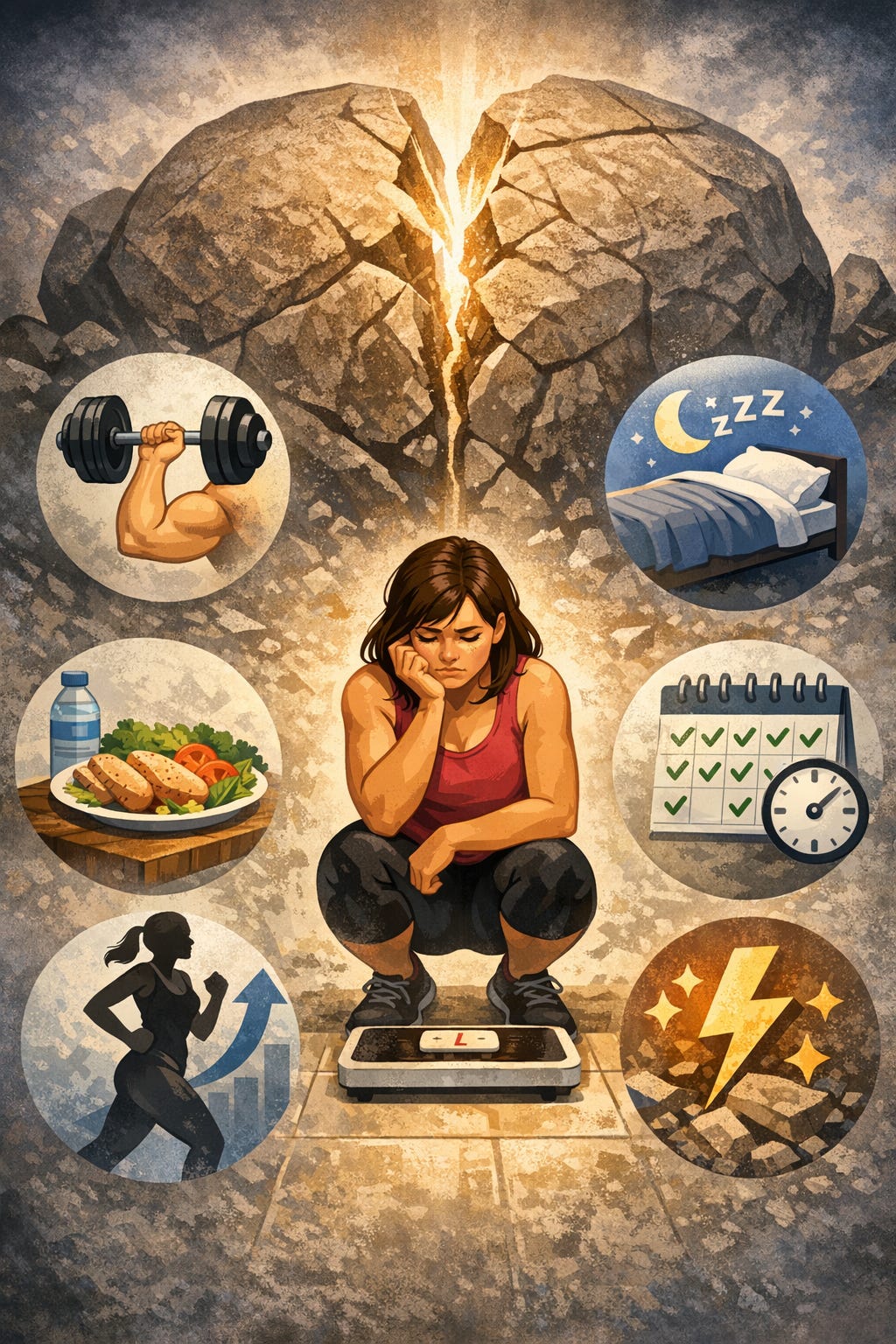
Image generated using Copilot AI.
How To “See” The Progress You’re Making
Here’s a five-step framework you can use to start understanding the progress you’re actually making.
1. Normalize the disruption (so you don’t quit when progress gets quiet)
People may fail because they interpret normal disruption as personal failure. A week of bad sleep. A stressful deadline. A missed meal. An illness. All of it can temporarily interfere with the metric you’re tracking. But disruption doesn’t mean you’re broken. It means you’re human. A helpful coaching stance is to treat setbacks like “chapters,” not “verdicts.”
Try adopting this mindset: My progress might be taking a detour, not stopping.
2. Build a restart protocol before you need it
If you only plan what to do when everything goes well, you’re betting your results on ideal conditions. Instead, create a minimum viable routine: the smallest version of your goal behaviour that you can do even during chaos.
For example:
Training: “If I can’t do my full workout, I do the warm-up plus five minutes of the main lifts.”
Nutrition: “If I’m off-plan, I don’t “start over,” I just stop the drift and return to my next planned meal.”
Steps/movement: “If my day goes sideways, I still get one walk. Short but complete.”
Then add an if-then plan: “If I miss a day, then I do X within 24 hours.” That’s how you prevent relapse from becoming a pattern.
3. Expand what “progress” means beyond the one number
When the main metric isn’t moving, it’s tempting to assume nothing is happening. But your body and brain are storing signals you can’t always see immediately.
Look for performance, recovery, and behaviour indicators. Things like:
Strength showing up in rep quality or technique (even without weight changes)
Sleep improving or fewer “crash days”
More energy for your life, not just more effort in training
Mood stability (less irritability, more steadiness)
Consistency building (e.g. you’re showing up more often, even if the scale is lagging)
This is crucial: sometimes the metric moves slowly because your progress is happening in the background. Especially around recovery, skill, and habit reliability.
4. Shift motivation from external accountability to intrinsic reasons
At first, many people rely on external pressure: a plan, a tracker, a coach, a number. Eventually, a sustainable change needs something deeper. Ask, “What is this effort buying me internally?”
More confidence.
Better self-trust.
Calmer days.
Stronger resilience.
The ability to recover faster after a bad day.
Those don’t always show up on your chart immediately, but they compound relentlessly.
5. Use reflective feedback instead of self-judgment
When you feel stuck, don’t just reassure yourself. Get curious. Try asking:
“What feels different, even if only slightly?”
“What has become easier to do than it used to be?”
“Where did I show up differently this week than last week?”
“What have I stopped struggling with that used to be top of mind?”
This protects agency. And it also gives you real data.
The Stonecutter’s Lesson: A Metaphor
There’s a story about a stonecutter who strikes a massive boulder over and over, at least 100 times, with the same motion, same aim, same effort. Each strike looks identical from the outside. No cracks appear. No visible progress shows up. Observers wonder about the strategy. It seems like a lot of work for nothing.
But then, on the 103rd strike, the boulder splits in two.
The point isn’t “be stubborn for no reason.” The point is this: progress can be invisible until…suddenly…it isn’t.
All the strikes that led up to the split weren’t wasted. They were the invisible work of weakening the structure, preparing the conditions for change. A stalled metric can feel like the universe is ignoring your effort, when in reality you may be building momentum neither you, nor anyone else, can see yet.
And there’s another lesson here that matters for your day-to-day follow-through. I harp on this often: consistency before intensity.
It’s not one heroic attempt. It’s hitting the same “spot” repeatedly (training the skill, reinforcing the habit, stacking the reps, tightening the routine) until the system finally crosses a threshold.
Why The Last Strike Works
So when you feel like giving up because the results aren’t arriving fast enough, remember the misconception people fall for: thinking the final blow is what matters most. The last strike gets the credit, but it only worked because of the hundreds that came before it.
If you’re not seeing cracks yet, don’t conclude that you’re not making progress. Ask a different question:
What evidence of invisible preparation is already happening under the surface?
An Invitation
If you’re ready to stay disciplined, taking action even when it seems you’re not making progress, head to the link in the show notes to join The ACT Score Challenge. You’ll put these principles, skills, and systems to daily use.
That’s it for today. Catch you next time.


