

Monday you were a runner. Tuesday you hit snooze. Wednesday your head wasn’t in it. Thursday you didn’t go. By Sunday night you’d already written off the whole week. This keeps happening. Not just with running, with everything.
You’re not undisciplined. You’re living in an environment with no edges.
Hey there. It’s me, Kore. And you’re listening to Exercising Consistency: From Fitness to Flourishing.
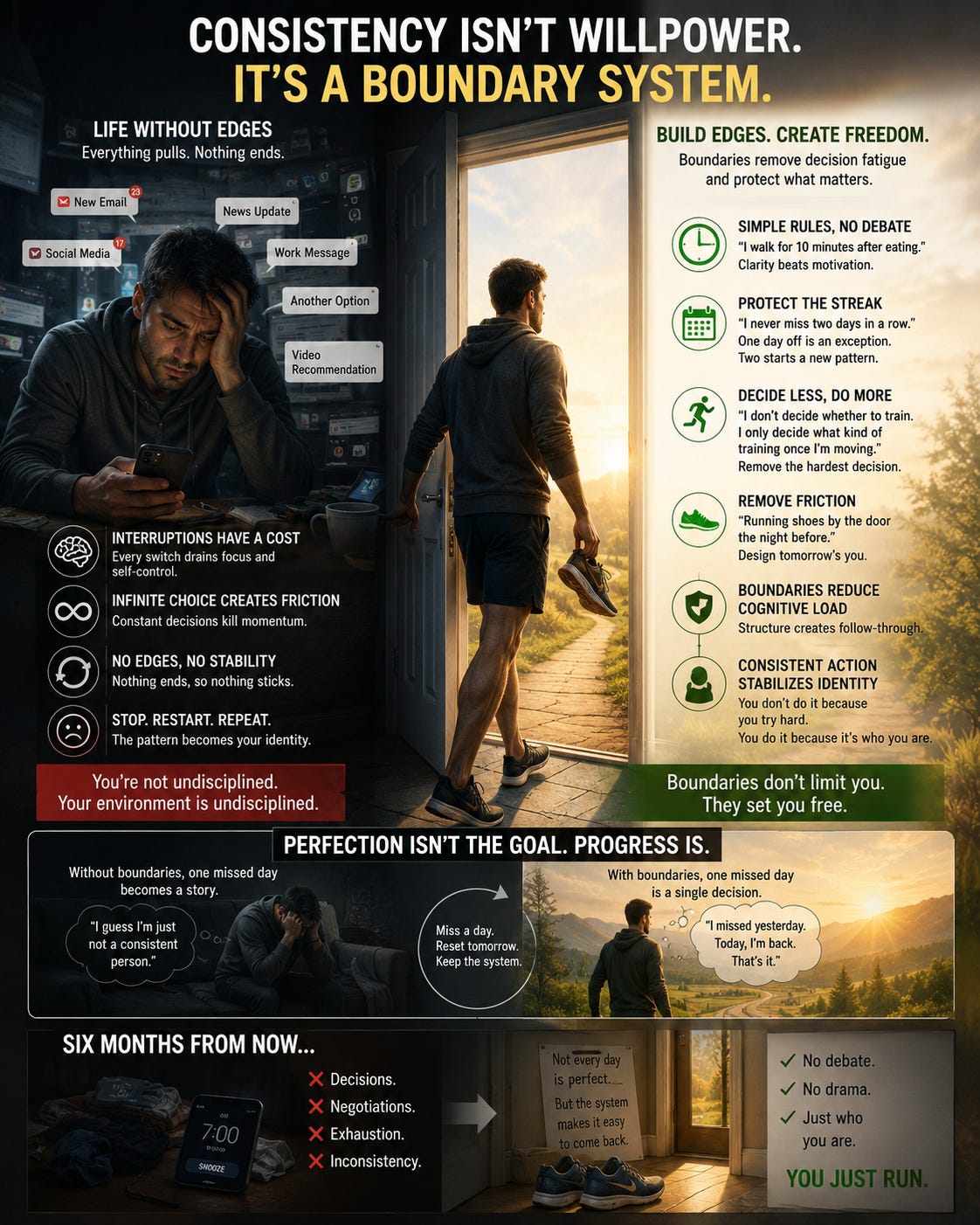
Image generated using ChatGPT.
Endless Options
Modern life has removed the natural boundaries humans used to rely on. Work doesn’t really end. Information doesn’t stop. Options are endless. Notifications keep coming. When nothing ends, stability becomes nearly impossible.
Every interruption has a cost. You were focused on something, then you got pulled away, and now your brain has to reestablish intention. What was I doing? Why was I doing it? What was the next step? That reset takes energy. It’s a self-control cost.
Modern life multiplies interruptions until that cost exceeds your capacity to keep paying it. When the cost gets too high, you stop. Then you restart. Then stop again. Over time, the pattern becomes familiar and reinforced.
We evolved in environments with limited choices. Today, you have infinite alternatives to whatever you’re doing right now. And infinite choice creates constant decision points:
Should I keep going?
Should I do something else?
Should I optimize this?
Should I wait until I feel ready?
Those tiny decisions seem harmless, but they drain momentum. Action gets replaced by scanning possibilities.
What you want is consistency. And consistency is, at its core, a boundary system.
The Solution: Simple Rules
We didn’t evolve in a world with endless open tabs. We evolved with built-in constraints. Sunlight dictated how long we could work. Scarcity limited options. Community shaped identity. Physical limits set the pace of life. Modern life removed many of those edges, and now we’re left trying to self-regulate inside a world that never tells us, “You’re done.”
So the move isn’t to shame yourself into trying harder. It’s to build the boundaries the environment no longer provides. Simple rules work because there’s nothing to negotiate. For example: “I walk for 10 minutes after eating.“ No debate. No need to feel motivated. You finish eating, you walk for 10 minutes. The rule is clear, and clarity beats intensity almost every time.
The same logic applies to exercise, where the stakes feel higher and the excuses get louder.
“I never miss two days in a row.“ One day off is recovery. Two is the start of a new pattern. No inner debate about whether you’re still on track.
“I don’t decide whether to train. I only decide what kind of training once I’m already moving.“ The hardest decision is ‘go or don’t go.’ Kill that one and the rest gets easier.
Simpler still: “Running shoes by the door the night before.” Because removing friction works better than adding willpower, and the person who puts the shoes out is the person who runs.
What Boundaries Provide
Boundaries reduce cognitive load. The brain works best with clarity and struggles with ambiguity.
Boundaries turn “maybe” into structure. Structure reduces the mental burden, and a reduced burden increases follow-through.
Boundaries also stabilize identity. When your actions are consistent, your identity becomes consistent. When your identity is consistent, your behaviour stops feeling like a daily decision.
Boundaries aren’t magic. You’ll still have days where the shoes sit by the door and you walk past them in the morning. The point isn’t perfection. It’s that missing a day inside a boundary system is a single decision you can reverse tomorrow. Missing a day without a boundary becomes a story: “I guess I’m just not a consistent person.” That story is harder to undo than any missed workout.
Six months from now, you’ll wake up and move before the decision even arrives. The shoes will already be by the door. The alarm won’t feel like a confrontation. You won’t be disciplined. You’ll just be the person who trains. Because you built an environment where trying hard wasn’t the point anymore.
An Invitation
When you’re ready to turn consistency from an idea into a lived experience, start Day 1 inside The ACT Score Challenge. Stack the days. Practice the reps that reshape your identity.
That’s it for today. Catch you next time.


