

The alarm goes off at 5:45, and for about four seconds you’re the person who set it the night before. Then the negotiation starts.
You know the voice. It’s reasonable. It points out that you didn’t sleep well, that the workout will still be there tomorrow, that one morning off won’t matter. And in that ten-second window, laying there feeling the fatigue, something invisible happens. Either you remember who you said you wanted to be, or you don’t.
That’s what discipline actually is. Not force. Not grit. Not pushing through discomfort while white-knuckling the steering wheel of your own life. It’s simpler than all of that: discipline is remembering.
Hey there. It’s me, Kore. And you’re listening to Exercising Consistency: From Fitness to Flourishing.
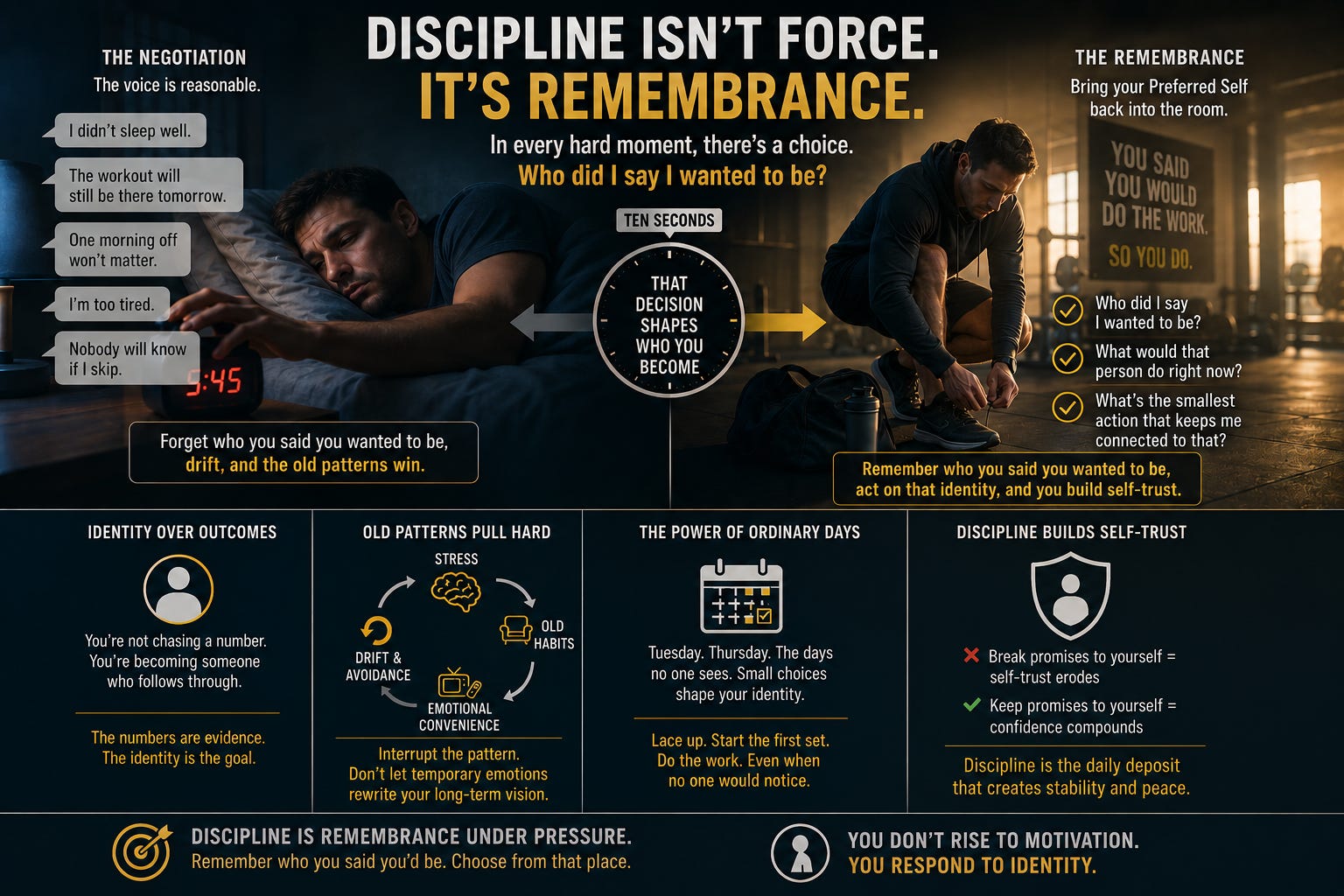
Image generated using ChatGPT.
Here’s why this reframe matters. When you treat discipline as force, you’re setting up a fight you will eventually lose. Because you get tired, because motivation comes and goes, because nobody wants to spend their life at war with themselves. But when you treat it as remembrance, every hard moment becomes a single question: Who did I say I wanted to be?
The Identity Layer
Every meaningful fitness goal starts with identity, not just outcomes. When you set the goal, you weren’t just saying “I want to lose 15 pounds“ or “I want to deadlift 315 for 5 reps.“ You were saying “I want to be the kind of person who follows through.“ The weight and the numbers are just evidence. The real project is become someone who does what they say they will do.
The problem is that identity decisions get made in clean conditions and tested in dirty ones. You decide who you want to be on Sunday evening. You’re calm, optimistic, well fed, looking at a fresh week. The future feels eminently doable then. But discipline doesn’t get tested on Sunday evening. It gets tested on Wednesday at 6 PM when you’re exhausted, the day was trash, and the couch is right there. It gets tested when comfort is calling and delaying feels harmless and nobody would know if you skipped.
That’s the moment. Not the gym. That pause, right there. Where you either remember or your attention drifts.
Here’s a great definition:
Discipline is remembrance under pressure.
It’s pausing long enough to bring your Preferred Self back into the room. It’s asking, “What would the person I said I wanted to be do, right now?” And then doing the smallest thing that keeps you connected to that answer. When you see it that way, discipline stops feeling like punishment and starts feeling like alignment.
The Pull of Old Patterns
Stress makes you forget. That’s the whole mechanism. You’re tired, the day was long, and the version of you who committed to training this morning feels like a stranger. So you skip because your attention drifted and the old default walked back in. Emotional convenience takes over. Decisions get made based on mood, comfort, and whatever gives temporary relief.
This is also why discipline is harder than it looks from the outside. You’re not just doing a workout. You’re interrupting patterns that have been reinforced for years. Your environment triggers old habits. Your routines pull you toward what’s familiar. And when you’re under pressure, that pull gets stronger. Discipline protects your long-term vision from being rewritten by temporary emotions. And not just in crisis moments, but on ordinary days.
The Ordinary Days
Ordinary days are where most of life happens. Tuesday. Thursday. The days where nothing dramatic happens and no one is watching. Those are the days your identity gets shaped the most. It’s the small choices that build the person you become: lacing up your shoes when you don’t feel like it, starting the first set before you negotiate with yourself, doing the work even when no one would notice if you didn’t.
From the outside, those choices don’t look like much. But inside, they’re identity-defining. Your brain learns who you are through what you repeatedly do.
When you consistently avoid what you know you should do, you teach yourself: I drift when things get inconvenient. When you follow through, especially on the days it would be easy not to, you teach yourself: I’m consistent even when circumstances aren’t ideal. Over time, those lessons become self-identity. That’s why discipline isn’t about intensity. It’s about congruence: keeping your actions connected to your values often enough that you stay recognizable to yourself whatever the circumstances.
This is also why a lack of discipline creates so much internal chaos. When your behaviour keeps violating your own standards, you stop trusting yourself. Those are quiet withdrawals, but they drain the account. And over time you stop making promises because you know you won’t have what it takes to keep them. If you don’t make any attempt to rebuild the account, self-trust erodes even further.
But when you remember who you said you’d be and act accordingly, your mind becomes settled. Your standards become stable. Stability creates peace.
Three Questions That Anchor You
Three questions you can ask yourself in the moment that matters:
Who did I say I wanted to be?
What would that person do, right now?
What’s the smallest action that keeps me connected to that?
Notice what’s missing from those questions: Do I feel like it? Feelings may be relevant, but they are not the decision-maker. Motivation changes. Energy changes. Moods change. Identity must be more stable than your mood. Discipline anchors your behaviour to something stronger than temporary emotion.
The Goal
The goal isn’t to become someone who is constantly pushing. The goal is to become someone whose actions naturally reflect their standards. Someone who remembers who they are. Someone who follows through in the gym and beyond. That’s the real discipline: repeatedly remembering who you said you’d be, and choosing from that place.
This is simple to understand and genuinely hard to do. The patterns you’re interrupting don’t give up easily, and your own brain is complicit. It will feed you reasons to stop, especially when you’re tired. Having a system and structure to build this skill is the difference between a philosophy you agree with and a practice that actually changes you.
When you’re ready to turn consistency from an idea into a lived experience, start Day 1 inside The ACT Score Challenge. Stack the days. Practice the reps that reshape your identity.
That’s it for today. Catch you next time.


