

When was the last time you skipped a workout because you couldn’t give it your full attention? That single question is the reason most people never build a consistent exercise habit.
Here’s what I mean. Let’s say you believe a workout doesn’t count unless it’s a full hour. You’d set your alarm for 6 AM, pack your gym bag, plan the ideal session. Then a late meeting, a bad night’s sleep, a rainy afternoon, something would nudge the conditions off ideal, and you’d say, “I’ll do it tomorrow.”
How surprised would you be if “tomorrow” turned into two weeks, or more, of missed workouts?
Now, what if instead of a full hour you started by setting a minimal standard workout length of 2 minutes? Too easy. And you decided to do it before your morning shower? Some jumping jacks, body weight squats, push ups, and a forward bend stretch to finish. Not very impressive.
And what if, every once in a while, you also feel inspired and decide to do 4 minutes instead? And a walk after lunch.
How much more likely are you to establish and maintain an exercise practice with the “too easy” 2-minute option?
Let’s find out.
Hey there. It’s me, Kore. And you’re listening to Exercising Consistency: From Fitness to Flourishing.
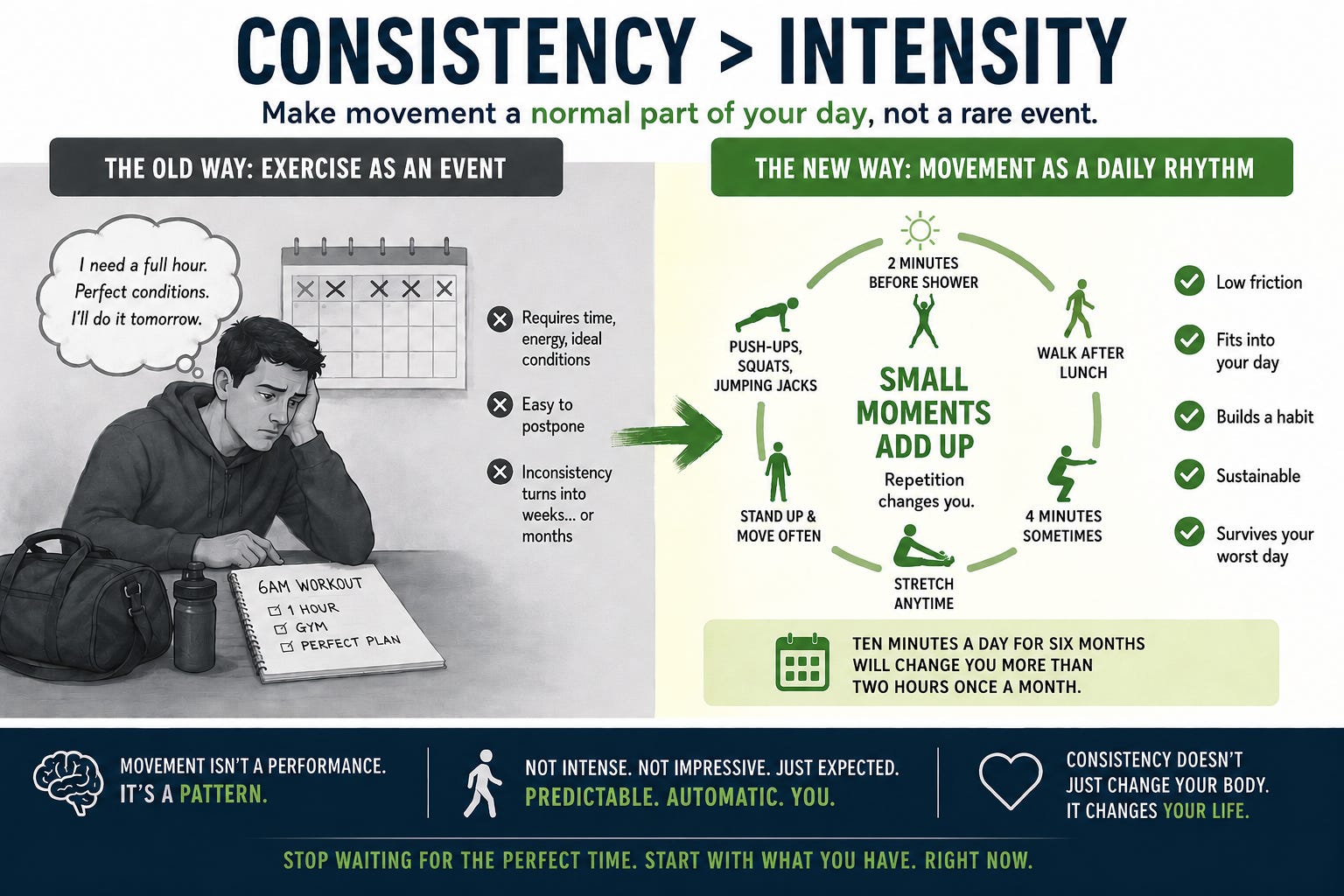
Image generated using ChatGPT.
The Problem With Exercise As An Event
That scenario, totally realistic by the way, isn’t about motivation. It’s about framing. Requiring a workout to be a full hour turns exercise into an event. Events require preparation. Events require the right conditions, enough time, enough energy, a sense that you can give it your full attention. Events are emotionally heavy. And when something is emotionally heavy, you postpone it.
Most people make exercise an event. They say:
“I need a full hour or it’s not even worth it.”
“I’m too busy today, I’ll double up tomorrow.”
“I don’t have the energy for a real workout.”
The moment exercise becomes an event, consistency is threatened. Events are easy to reschedule. And rescheduling is just a polite word for quitting.
Make Exercise Part Of Your Daily Rhythm
Look at how you treat the behaviours you never skip. You don’t need to feel inspired to brush your teeth. You don’t debate whether you’re going to eat breakfast. You don’t watch a motivational video to get yourself to shower. These things are integrated. They’re not performances. They don’t require emotional buildup. They just happen because they’re part of the rhythm of your day.
Exercise Events Have Their Place
Now, there are times when treating exercise like an event makes sense. If you’re training for a marathon, if you’re preparing for a competition, if you have a specific performance goal with a deadline? That’s when you need the big block, the full focus, the intensity.
But here’s what most people get wrong: they treat that exceptional model as the default. They think every workout needs to feel like race prep. And when it doesn’t, they assume it’s not worth their time.
The Effective Exercise Default
The default should be the opposite. Small signals. Daily rhythms. Low-friction actions. Taking advantage of the two minutes or five minutes you have rather than waiting for the one-hour block. The body responds to repetition, not just intensity. Ten minutes a day for six months will change you more than two hours once a month. That’s not a motivational platitude. That’s what repetition does to the nervous system.
This is the shift that matters. Stop asking, “How do I make time for a real workout?“ Instead start asking, “How do I make movement a normal part of my day?“ The answer is almost never an uninterrupted hour. It’s small moments stacked over the course of the day. Those add up. And they add up because you actually do them.
When Movement Has Become Normal
When movement is normal, it stops requiring emotional momentum. You don’t need to get psyched up. You don’t need ideal timing. You don’t need a major psychological buildup. Walking counts. Stretching counts. Standing up from your desk and moving through your space for a few minutes counts. Sustainability is built on the stuff that doesn’t feel like a big deal.
The goal is not a perfect workout. It’s a life where movement doesn’t feel separate from who you are. Not intense, not impressive, not extraordinary. Just expected. Predictable. Automatic enough that it survives your worst day.
That’s what consistency actually looks like. And that’s what changes your body, your brain, and the person you become.
An Invitation
When you’re ready to turn consistency from an idea into a lived experience, start Day 1 inside The ACT Score Challenge. Stack the days. Practice the reps that reshape your identity.
That’s it for today. Catch you next time.


